Lawyers in Gurgaon
Sale deed registry · Gurugram district
Property Registration
in Gurgaon
Sale deed drafting, token filing and registration support across Gurugram district.
L.I.G. handles your sale deed registration in Gurgaon from start to finish. We draft the deed, check your documents, file the token, respond to objections, coordinate government payments and book your appointment. We accompany you to the Sub-Registrar’s office and follow up until your registered deed is ready.
The initial discussion is free. Detailed review, drafting and registration work follow an agreed scope and fee.
Token reverted? See the objections we clearUpdated · Haryana paperless registry
Registry at a glance · 2026
- Urban sale deed duty
- 5% women · 6% joint · 7% men
- Floor-wise duty
- Extra 1% where the policy applies
- Registration fee
- Fixed slab, max ₹50,000
- Registry appointment
- In-person verification
- System
- Paperless since 1 Nov 2025
End-to-end registry service
Sale deed registration
in Gurgaon
L.I.G. Documentation & Registration Services handles the drafting, the pre-filing check, the token, any objection and the registry day, at all nine Sub-Registrar offices in Gurugram district.
Sale deed drafting
Drafted for your transaction on the Deed Registration portal: consideration, payment mode, possession, title assurance and indemnity.
Name, area and Property ID check
Before filing, we match the names and area across the previous deed, applicable Property ID and NDC, and party IDs. We check e-KYC readiness and any DTP approval needed for the transaction.
Token filing and scrutiny
We file the token and follow its scrutiny through the registration office’s current workflow, responding to remarks before the Sub-Registrar’s approval.
Reverted tokens
When the office reverts a token, we answer the remark and fix its cause: rectification, Property ID, a loan or stay entry, the OC, or 7A.
Stamp duty, fee and slot
We calculate duty on the higher of the sale price and the collector-rate value, pay online once the token clears and book the appointment.
Appearance and mutation
Buyer, seller and witnesses attend the appointment for verification, photographs and biometrics. We follow up for the registered copy and explain how to track mutation where applicable.
Send a screenshot of the reversion remark with your previous deed and the Property ID. We will tell you what the office is asking for and what it takes to clear it. See the seven common objections.
Why buyers and sellers use us
Checked before
it is filed
Most registry delays start before the token goes in: a name, an area or a Property ID that does not match. We check the records behind the deed, not just the deed.
Records matched before filing
Names and area are matched across the previous deed, the Property ID, the NDC and every ID before the token is uploaded.
Objections answered, not just typed
When the Sub-Registrar reverts a token, we answer the remark and fix its cause, from a rectification deed to a 7A clarification.
All nine offices in the district
Gurugram, Wazirabad, Badshahpur, Kadipur, Harsaru, Manesar, Sohna, Pataudi and Farrukhnagar.
A chamber at the District Court
Chamber No. 153, 2nd Floor, Block C, District & Sessions Court, Gurugram, and one WhatsApp number from draft to registered copy.
Before paying bayana
What to check before signing a sale deed in Gurgaon
Check the seller’s authority, the chain of ownership and the property details before paying a deposit. The registered sale deed records the transaction and transfers the rights the seller holds.
Check the seller and the property
- Compare the seller’s ID and authority to sell with the latest registered deed and earlier title documents.
- Check for any mortgage, court order or restriction affecting the sale.
- Match the plot or unit number, area and share across the deed and the applicable property records.
Check what the sale deed records
- Record the agreed price, amounts already paid, any balance and the payment method.
- State when possession is handed over and who is responsible for earlier dues.
- Describe parking, terrace, access and common-area rights where they form part of the sale.
Supreme Court judgment on registration and the seller’s title
Haryana registry update · 19 November 2026
What to prepare under the updated registry workflow
The 19 November update covers party e-KYC, OTP verification and DTP approval. The portal notice also specifies accepted GRN heads and exact second-party name matching. Special Khasra and Tatima changes are announced for the following-week phase. We check the requirements that apply to your property before filing.
Party e-KYC and first-party OTP
The departmental update states mandatory Aadhaar-based e-KYC for all parties. The portal notice separately explains first-party OTP routing: the Indian-citizen route uses the Aadhaar-linked mobile; the NRI route uses the entered mobile number. It also explains OTP routing for an authorised person acting for the first party, as set out below.
DTP approval, including existing NOCs
For land under the Town and Country Planning Department, registration tokens go directly to DTP for verification and approval. The citizen can book the registration appointment only after DTP approval. The briefing also routes existing NOCs through DTP approval and discontinues the ULB approval/unapproval check in this workflow. Check municipal NDC separately. Read the NOC versus NDC guide.
Special Khasra: check every co-owner’s share
The announced condition permits a Special Khasra sale only when all co-owners of that khasra are selling their respective shares. Check the owners and shares against the revenue record. This specific condition should not be extended to every sale of an undivided share.
Tatima upload where applicable
Where a Tatima map applies, the announced change makes its upload before registration mandatory. Confirm applicability and match the map to the deed and revenue record. The briefing does not require a Tatima for every flat or other property transaction.
Which mobile number receives the OTP?
The portal makes OTP verification mandatory for the first party and sets out these routes for the first party or a person acting on their behalf.
| Person / portal route | OTP destination |
|---|---|
| First party: Indian-citizen route | That first party’s Aadhaar-linked mobile number. |
| First party: NRI route | The mobile number entered by that first party. |
| Authorised person for the first party: Indian-citizen route | The authorised person’s own Aadhaar-linked mobile number. |
| Authorised person for the first party: NRI route | The mobile number entered by the authorised person. |
Keep the relevant mobile number active. These instructions explain OTP routing; they do not establish a blanket Aadhaar exemption or replace identity-document and appearance requirements. Confirm the accepted documents for a foreign-national or other case not covered by the notice.
GRN heads and second-party name matching
The portal notice says it accepts GRNs under these heads and rejects GRNs generated under other heads:
| Head | Fee label in the notice |
|---|---|
| 0030 | Registration fee |
| 0029 | Mutation fee |
Match the second party’s name exactly: the name in the stamp/GRN details must be identical to the name in the portal’s second-party details. Resolve spelling or other name differences before submission.
Ask the concerned officer or stamp vendor to use the applicable accepted head. These are GRN acceptance instructions; stamp duty and other applicable charges must still be calculated and paid separately as required.
Sources: Revenue and Disaster Management Department, Haryana — “System Update – For Information” briefing, plus the Haryana e-registration portal “Important Information” notice captured on 19 November 2026. The portal notice provides the DTP appointment condition, OTP routes, GRN heads and second-party name-matching instruction. Special Khasra and Tatima are listed for the following-week phase without an exact calendar activation date. Confirm that phase before submitting an affected transaction. Read the full paperless registry update.
The 2026 paperless process
How property registration
works in Gurgaon
Haryana’s Paperless Registration 2.0 system handles deed entry, document upload, scrutiny, payment and slot booking online. The parties and witnesses attend the scheduled Sub-Registrar appointment. These are the nine steps from document review to the registered deed.
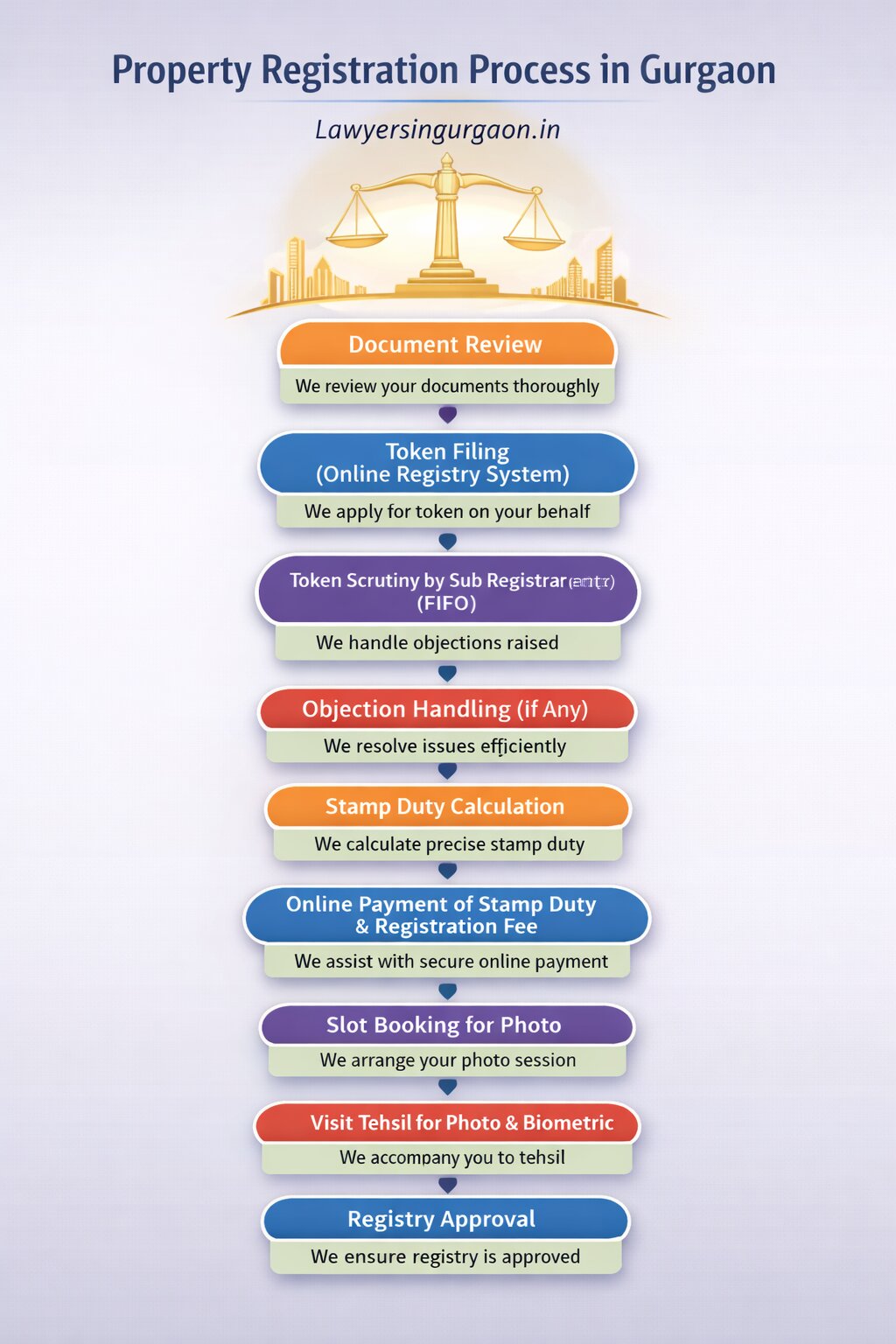
Document review
We check the previous registered deed, party IDs, photographs, names and property particulars. For municipal property, check the applicable Property ID, dues and ULB NDC; its validity is three months unless the government sets another period. Where Section 7A NOC applies, check DTP approval, including the approval route for an existing NOC. For an affected land sale, also check the announced Special Khasra and Tatima requirements and their activation.
Token filing on the online registry system
Prepare the sale deed, complete the applicable party e-KYC and first-party or authorised-person OTP verification, upload the required identity and title documents, and file the token. For land under Town and Country Planning, the token goes directly to DTP for verification and approval. Under the activated Tatima workflow, upload the map before registration where applicable. The registering office accesses the Jamabandi through the portal; a required Tatima upload remains separate.
Token scrutiny by the Sub-Registrar (FIFO)
Tokens are scrutinised in the applicable first-in-first-out workflow by the registration office and Sub-Registrar. We track the status and respond to the scrutiny remarks shown on the portal.
Objection handling, if any
If the records do not line up, the token comes back with a remark. We answer it, fix the cause and refile. The seven most common objections are listed below.
Stamp duty calculation
We compare the sale price with the collector-rate valuation and calculate the applicable duty on the higher amount. The registration fee follows the sale deed fee slabs.
Online payment of stamp duty and fee
Pay the applicable stamp duty and fees through the prescribed process. For GRN acceptance, the portal notice lists head 0030 for registration fee and 0029 for mutation fee; other GRN heads are not accepted. Check that the second party’s name in the stamp/GRN details exactly matches the portal entry before submission.
Appointment booking after required approvals
For land under Town and Country Planning, the portal permits a citizen to book the registration appointment only after DTP approval. Once the required approvals and payment checks are complete, select an available Sub-Registrar appointment through the applicable booking facility.
Tehsil visit for photo and biometrics
The buyer, seller and two witnesses bring original IDs to the appointment for verification, photographs and biometrics. Confirm the paperwork in advance if a party will appear through an authorised representative.
Registry approval
After approval, collect or download the registered copy. Where auto-mutation applies, track the entry and compare it with the latest Jamabandi. If incorporation is complete but the portal remains pending, or the print contains an error, seek the appropriate departmental correction. Read the mutation and SDM-function guide.
Official portals behind each step
Deeds and tokens are filed on the Deed Registration Website. Appointment slots show on Jamabandi, and the Property ID and NDC sit on the ULB property portal.
Our guides: booking the token and appointment, paperless registry and auto-mutation, and the 2026 token escalation and loan-entry circular.
Stamp duty and registration fee · 2026
Property registration
charges in Gurgaon
For a standard urban sale deed in Gurgaon, the usual duty rates are 5% for a woman buyer, 6% for a man and woman buying jointly, and 7% for a man buyer. Use the higher of the sale price or the applicable collector-rate valuation. Registration fees follow separate value slabs.
For a standard sale deed, the registration fee follows value slabs and reaches ₹50,000 above ₹90 lakh.
| Buyer | Standard rate | Floor-wise rate where the extra duty applies |
|---|---|---|
| Woman | 5% | 6% |
| Joint (man and woman) | 6% | 7% |
| Man | 7% | 8% |
| Assessable value | Buyer | Stamp duty | Fee | Subtotal |
|---|---|---|---|---|
| ₹40 lakh | Man | ₹2,80,000 | ₹20,000 | ₹3,00,000 |
| ₹40 lakh | Woman | ₹2,00,000 | ₹20,000 | ₹2,20,000 |
| ₹75 lakh | Man | ₹5,25,000 | ₹40,000 | ₹5,65,000 |
| ₹1.2 crore | Joint | ₹7,20,000 | ₹50,000 | ₹7,70,000 |
| ₹1.5 crore builder floor | Woman | ₹9,00,000 | ₹50,000 | ₹9,50,000 |
| Assessable value, up to and including | Registration fee |
|---|---|
| ₹50,000 | ₹100 |
| ₹1 lakh | ₹500 |
| ₹5 lakh | ₹1,000 |
| ₹10 lakh | ₹5,000 |
| ₹20 lakh | ₹10,000 |
| ₹25 lakh | ₹12,500 |
| ₹30 lakh | ₹15,000 |
| ₹40 lakh | ₹20,000 |
| ₹50 lakh | ₹25,000 |
| ₹60 lakh | ₹30,000 |
| ₹70 lakh | ₹35,000 |
| ₹80 lakh | ₹40,000 |
| ₹90 lakh | ₹45,000 |
| Above ₹90 lakh | ₹50,000 |
Example when the collector valuation is higher
If the agreed price is ₹70 lakh and the applicable collector valuation is ₹75 lakh, use ₹75 lakh for this example. At a 7% rate, stamp duty is ₹5,25,000 and the registration fee is ₹40,000, for a subtotal of ₹5,65,000. The L.I.G. professional fee and any other applicable charges are separate.
At exactly ₹30 lakh the registration fee is ₹15,000. The ₹20,000 slab starts above ₹30 lakh and runs through ₹40 lakh. At ₹40,00,001 the fee moves to ₹25,000.
Haryana registration fee notification S.O. 65, 3 October 2018 · Official Gurugram collector rates for 2026–27
Stamp duty on a floor-wise sale
The table shows the additional 1% for independent floor-wise sales where the policy applies. On HSVP plots, confirm HSVP’s permission and the land-share and construction valuation before calculating the duty.
HSVP floor-wise registration policy · Stamp duty and registration fee calculator · Full Gurgaon registration charges guide
From our registry files
Gurgaon registry
case studies
Client details are withheld. Each case shows the objection, what we did and the result.
Case study 01 · Area mismatch
The Property ID area didn’t match the title deed
- The problem
- The area recorded against the client’s Property ID did not match the area in the title deed, a mismatch that gets a token reverted at scrutiny.
- What we did
- We filed the supporting papers with the token and explained the difference between the Property ID and title deed to the Sub-Registrar during scrutiny.
- Outcome
- The token was approved.
Case study 02 · Section 7A
A repeated Section 7A NOC objection
- The problem
- The registry filing was returned more than once with a request for a Section 7A NOC from the District Town Planner.
- What we did
- We showed the Sub-Registrar’s office that the property’s khasra fell within the area covered by the ULB approval in this case.
- Outcome
- The 7A objection was dropped.
This case records the approval evidence used for that file. For a current filing, also check the 19 November DTP approval workflow and the transaction’s applicable requirements.
Stuck at the Sub-Registrar?
Send the remark.
Get a straight answer.
Share a screenshot of the reversion remark with the previous deed and the Property ID. We will tell you what the office wants, what it takes to clear it and the fee.
Before the token is filed
Documents for property
registration in Gurgaon
Send clear scans of what you have. We match the names and the area across all of them before anything is uploaded.
The registering office accesses the Jamabandi through the portal. The announced Tatima-map upload is a separate, property-specific requirement for the next phase; confirm its applicability and activation before filing.
Send Documents on WhatsApp- Sale deedRecords the parties, the property, the terms of sale and the rights transferred.
- Transaction and payment detailsKeep the agreement to sell, if signed, and the agreed price, payments made, balance and possession date ready so the deed reflects the deal.
- PAN and photo IDOf the buyer, the seller and two witnesses; Form 60 where a party has no PAN.
- Party identity and an active mobile for OTPMatch identity details with the deed. For the first party or their authorised person, use the Aadhaar-linked mobile under the Indian-citizen route or the entered mobile under the NRI route. See the exact OTP routes.
- Stamp / GRN details and matching second-party nameCheck the accepted GRN head: the notice lists 0030 for registration fee and 0029 for mutation fee. The second party’s name in stamp/GRN details must match the portal’s second-party entry exactly.
- PhotographsOf the parties, for the portal and the registry day.
- Previous registered deedThe seller’s sale, transfer or conveyance deed identifies the property and the seller’s title. Bring earlier title documents where relevant.
- Property ID and NDCFor property in a municipal area; the NDC is valid for three months unless the government sets another period. When an NDC or a NOC applies
- DTP NOC approval, where applicableKeep the NOC reference and check DTP approval status. For land under Town and Country Planning, DTP approval must precede appointment booking. Existing NOC holders can get approval on the DTP portal. Municipal NDC remains a separate check.
- Special Khasra and Tatima, for affected land salesFor the announced next phase, check the Special Khasra co-owner condition and obtain the Tatima where applicable. Confirm activation and match the map, owners and shares before filing.
- Collector-rate referenceThe rate for the property’s locality and category helps establish its collector valuation. Collector rates in Gurgaon
Extra papers by property type
What your property
adds to the file
Use the checklist above for the core file, then check the approvals and records that apply to your property type.
Builder flat or floor
Match the flat or floor with the occupation certificate and the conveyance or allotment papers. Check builder or maintenance dues for a resale.
Society or cooperative property
A society NOC. Society NOC for registry
HSVP plot
HSVP no-dues and transfer papers for the plot. Selling a building on it floor-wise needs HSVP’s prior permission.
Plot in a notified urban area
Check whether the plot and deed fall within Section 7A and whether an exemption applies. Where NOC is required, confirm DTP approval under the revised workflow, including for an existing NOC. Municipal NDC is a separate check. Controlled area, urban area and 7A
Family or inherited property
Mutation and succession papers. Transfers within the family use a transfer deed, gift deed or relinquishment deed.
Commercial property
Match the unit number, area and permitted use with the previous conveyance and approved papers. Check any transfer consent required under the allotment terms.
DDJAY plot or floor
For a Deen Dayal Jan Awas Yojana property, check the plot number, area and phase against the approved layout. For a floor sale, confirm the sanctioned plan and the floor and common rights being conveyed.
Owner abroad or unable to attend
Confirm the power of attorney and accepted identity documents before booking. The portal’s NRI OTP route sends the code to the entered mobile number. Where an authorised person acts for the first party, OTP goes to that person’s Aadhaar-linked mobile under the Indian-citizen route or their entered mobile under the NRI route. Keep that number active. Register a GPA · NRI property registration
Gurugram district
Sub-Registrar offices
we file at
The property’s location determines the registering office. We file across Gurugram district’s nine offices and can check the jurisdiction from the property details.
How do I find the right Sub-Registrar office?
Start with the sector, colony or revenue village on the previous deed. Keep the plot or flat number, or the khasra number for land, handy. Confirm the office for that address before selecting a slot on Jamabandi.
Buying in Gurgaon while living elsewhere in Delhi NCR? The deed generally goes to the office with jurisdiction over the Gurgaon property. You can begin the document review remotely and confirm the appearance arrangements before booking.
Registration Act, 1908, Section 28 · Official tehsil-wise collector rates · Jamabandi appointment slots
L.I.G. professional fee
From ₹10,000
What the fee covers
The quote depends on the deed, the property and any objection that needs fixing. Stamp duty and the registration fee are paid to the government separately.
- Sale deed drafting on the portal
- Name, area, Property ID and NDC check before filing
- Token filing and tracking through scrutiny
- Replies to objections if the token is reverted
- Stamp duty calculation, payment and slot booking
- Support on the registry day
Registry quote on WhatsApp
Tell us about the property.
We reply with the fee.
Choose the office, the deed and where the token stands. WhatsApp opens with your message ready to send.
- Pick the office and the deedIf you are unsure of the office, select Not sure and enter the sector, colony or village in the details field.
- Say where the token standsNot filed, under scrutiny or reverted with a remark.
- Get the fee and the checklistWe reply with the professional fee and the documents to send.
Prefer to call? Call 8796021579.
Questions before you register
Property registration
in Gurgaon: FAQs
Straight answers on the 2026 process, charges, documents and objections.
Where does the first party receive the registration OTP?
The portal makes OTP verification mandatory for the first party. Under the Indian-citizen route, the OTP goes to that first party’s Aadhaar-linked mobile number. Under the NRI route, it goes to the mobile number entered by that first party. The relevant number must be active.
Who receives the OTP when an authorised person acts for the first party?
The notice sends the OTP to the authorised person’s own Aadhaar-linked mobile under the Indian-citizen route, or to the mobile number entered by the authorised person under the NRI route. These instructions concern a person acting for the first party; they do not replace the requirement to establish that person’s authority.
Which GRN heads does the Haryana registration portal accept?
The Important Information notice captured on 19 November 2026 lists head 0030 for registration fee and head 0029 for mutation fee. It says GRNs under other heads will not be accepted. Ask the concerned officer or stamp vendor to generate the applicable GRN under the correct head. These labels describe GRN acceptance and do not replace the separate stamp-duty calculation.
Must the second party’s name match the stamp or GRN details exactly?
Yes. The portal notice requires the second party’s name in the stamp/GRN details to be exactly the same as the name entered in the portal’s second-party details. Resolve any difference before submission because a mismatch can cause processing problems.
Is Aadhaar e-KYC mandatory for property registration?
The departmental update states mandatory Aadhaar-based e-KYC for all parties. The portal notice also provides different OTP routes: the first party’s Aadhaar-linked mobile under the Indian-citizen route and their entered mobile under the NRI route, with corresponding routes for an authorised person. The OTP instruction alone does not establish a blanket Aadhaar exemption. Confirm the identity documents accepted for the transaction.
What changes if I already have a DTP NOC?
The briefing says existing NOC holders can get it approved on the DTP portal. The portal notice adds that tokens for land under Town and Country Planning go directly to DTP for verification and approval, and citizens can book the registration appointment only after DTP approval. Check the existing NOC and approval status. Municipal NDC requirements remain a separate check.
Is a Tatima map needed for every flat or property registry?
The briefing announces mandatory upload before registration where a Tatima map is applicable, in the following-week phase. It does not impose a Tatima requirement on every flat or property transaction. Confirm applicability and activation for the proposed transaction; no exact calendar activation day is stated in the briefing.
Do all co-owners have to join a Special Khasra sale?
The announced next-phase condition allows a Special Khasra sale only when all co-owners of that khasra are selling their respective shares. Check the Jamabandi, owners and shares and confirm activation before filing. This specific condition should not be presented as a blanket rule for every sale of an undivided share.
Can property registration in Gurgaon be done fully online?
Deed filing, scrutiny, payment and slot booking run online in Haryana. The buyer, seller and witnesses normally attend the Sub-Registrar appointment in person for verification, photographs and biometrics.
How much does property registration cost in Gurgaon?
For a standard urban sale deed, stamp duty is usually 5% for a woman buyer, 6% for a man and woman buying jointly, and 7% for a man buyer. At a ₹75 lakh assessable value and 7% duty, stamp duty is ₹5,25,000 and the registration fee is ₹40,000. The ₹5,65,000 subtotal covers those two charges. Estimate your charges.
Is stamp duty higher for a builder floor in Gurgaon?
An extra 1% applies to independent floor-wise transfers covered by the applicable policy. For an HSVP plot, check HSVP’s permission and the floor valuation before payment. See the HSVP floor-wise policy.
Is the registration fee 1% of the property value in Haryana?
Haryana’s sale deed registration fee follows value slabs. It is ₹15,000 at exactly ₹30 lakh, ₹20,000 above ₹30 lakh through ₹40 lakh, and ₹50,000 above ₹90 lakh.
Is stamp duty charged on the sale price or the collector rate?
Use the higher of the sale consideration and the collector-rate valuation applicable to the property. Check the official Gurugram collector rates for 2026–27 for the property’s location and category.
Which documents are needed for property registration in Gurgaon?
Prepare the sale deed, previous registered deed, party and witness IDs, PAN or Form 60 where applicable, photographs and payment details. Prepare party details for the required Aadhaar e-KYC. Add Property ID, municipal NDC, DTP NOC approval, occupation certificate or HSVP papers where applicable. For affected land sales, check the Special Khasra condition and Tatima requirement in the announced next phase.
Why does the Sub-Registrar revert a registry token?
Common remarks include mismatches in names, area or the Property ID, a mortgage or court order still showing in the record, an occupation certificate discrepancy or a request for a Section 7A NOC. The remark identifies the issue to address before refiling.
Is a Section 7A NOC needed for a property in an approved colony?
It depends on the notified area, the parcel and the transaction. Check whether the khasra is covered by the relevant approval or exemption and retain proof for scrutiny. See the Haryana Assembly explanation of Section 7A.
How long is an NDC valid for property registration?
Three months under the Haryana municipal laws, unless the government sets another period. The NDC is generated on the ULB portal against the Property ID once the dues are cleared. When an NDC or a NOC applies.
Do the buyer and seller both have to be present?
The parties normally attend the registry appointment with the witnesses. A duly authorised representative may appear where permitted under the Registration Act. Confirm the power of attorney and identification requirements before booking.
Which Sub-Registrar office registers my property?
Use the office whose jurisdiction covers the property. Start with the sector, colony or revenue village in the previous deed and confirm the office before booking. The Gurugram district offices include Gurugram, Wazirabad, Badshahpur, Kadipur, Harsaru, Manesar, Sohna, Pataudi and Farrukhnagar.
Do I need a lawyer for property registration in Gurgaon?
You may file the deed yourself through the paperless system. A lawyer can help verify title, check the clauses in the sale deed and advise on issues raised during scrutiny.
What does your professional fee cover?
L.I.G. Documentation & Registration Services charges from ₹10,000. The scope covers sale deed drafting, document checks, token filing and follow-up, duty calculation and payment coordination, slot booking and registry-day assistance as agreed. Stamp duty, the registration fee and other applicable government charges are separate.
What should I verify before paying bayana for a Gurgaon property?
Check the seller’s title documents and authority to sell, any mortgage or court order, and whether the property number and area agree across the deed and the applicable records. Confirm payment milestones and the possession date in writing. See the buyer checklist.
Can I register a Gurgaon property if I live in Delhi NCR?
Yes. If the property is in Gurugram, the deed generally goes to the Sub-Registrar office with jurisdiction over that property. Start the document review remotely and confirm who will attend the appointment.
Official portals
Where the registry
happens online
The government portals behind each step. We work on them for you, and you can check each step yourself.
This page gives general information on property registration in Haryana. What a particular deed needs depends on its facts and on the Sub-Registrar’s scrutiny. Documentation and registration work is handled by L.I.G. Documentation & Registration Services. Lawyers in Gurgaon facilitates access to independent advocates; it does not itself provide legal representation.