Gift Deed vs Transfer Deed in Haryana – Which Property Transfer Document Should You Use?
Many property owners in Haryana use the phrase transfer deed loosely. In real legal practice, the correct document may instead be a Gift Deed, Sale Deed, Relinquishment Deed, Family Settlement, Partition Deed or another instrument depending on the facts. Choosing the wrong deed can affect stamp duty, registration, mutation, future resale and dispute risk.
Quick answer
A Gift Deed is a specific document used where property is voluntarily transferred without sale consideration. By contrast, transfer deed is often a loose public phrase that may refer to several different legal instruments. In Haryana practical usage, many people also use the phrase transfer deed for transfer within blood relation. If the transaction involves payment, inherited share adjustment, co-owner release or family settlement, a document other than Gift Deed may be more suitable.
In practical terms, the real decision is often: Gift Deed vs Sale Deed vs Relinquishment Deed vs Family Settlement vs Partition arrangement — not merely Gift Deed vs Transfer Deed as labels.
Transfer deed within blood relation in Haryana – practical understanding
In Haryana practice, many people use the expression transfer deed to describe transfer of property within blood relation without sale consideration. So when users search for transfer deed, they often mean:
- transfer from parent to child
- transfer between husband and wife
- transfer between siblings
- transfer within specified family relationships without sale price
In certain specified family relationships, transfer within blood relation may receive different stamp duty treatment compared with a normal sale transaction. This is why many people in Haryana use the phrase transfer deed when discussing family transfer.
However, the actual legal position still depends on the exact relationship category, the ownership history and the document structure used at registry.
Stamp duty exemption or concession does not automatically apply to all relatives. Only limited and recognised relationships may fall within exempt or concessional category depending on the prevailing legal provisions and documentation.
Incorrect assumption regarding blood relation eligibility can lead to objection or wrong deed selection at the time of registration.
What people usually mean by “transfer deed” in Haryana
In ordinary conversation, many people say:
- I want to make a transfer deed to my son.
- Can I transfer property to my wife through transfer deed?
- What are transfer deed charges in blood relation?
But from a drafting perspective, the transfer may actually need one of these:
- Gift Deed
- Sale Deed
- Relinquishment Deed
- Family Settlement
- Partition Deed
- Release of share in a co-ownership context
The correct deed depends on consideration, relationship, title history, whether the property is inherited or self-acquired, whether the transferee is already a co-owner, and what rights are actually being conveyed.
What is a Gift Deed?
A Gift Deed is generally examined where one person voluntarily transfers property to another without sale consideration. It is commonly discussed in family contexts such as parent-to-child, spouse-to-spouse or similar non-sale transfers, but the suitability still depends on title and facts.
- the transfer is voluntary
- no sale price is being paid
- ownership is intended to pass clearly through a registered instrument
- the transferor has the legal right to make such transfer
- the transaction is genuinely a gift and not a disguised sale or settlement
Even where no sale consideration is paid, Gift Deed may still attract stamp duty calculated on collector rate depending on the transaction structure and the relationship category involved.
That is why users often compare Gift Deed with transfer within blood relation while planning family transfer in Haryana.
People often say “I want to transfer the property.” The better legal question is: is this actually a gift, or is it really a release, sale, settlement or share adjustment?
In practice, Gift Deed and transfer within blood relation are often discussed together because both may involve family transfer without sale price, but the stamp duty treatment and document suitability are not always the same.
Gift Deed vs Transfer Deed in Haryana – practical comparison
| Factor | Gift Deed | Transfer Deed as commonly used |
|---|---|---|
| Legal status | A specific legal instrument used for transfer without sale consideration. | Usually a generic phrase, but in Haryana public usage often refers to family transfer within blood relation. |
| Consideration | Normally no sale consideration. | Often discussed where there is no sale consideration, though the real structure must still be checked. |
| Typical use | Voluntary family or non-sale transfer situations. | Informal umbrella term used by the public for many ownership transfer documents, especially blood relation transfer. |
| Dependence on facts | Yes — title history and nature of transfer matter. | Yes — because the actual document may need to be Gift Deed, Relinquishment, Release, Family Settlement or another instrument. |
| Stamp duty impact | May still apply on collector rate depending on the relationship category and transaction structure. | Often discussed in the context of exempt or concessional family transfer, but only for limited recognised relationships and correct structuring. |
| Future dispute risk | Reduced if correctly chosen, drafted and registered. | Higher if the generic label is used without matching the real legal position and title facts. |
| Post-registration follow-up | Mutation or record update may still be required. | Same — registry is not the end of the story in every case. |
Quick visual guide
This flowchart gives a practical visual overview of how Gift Deed, transfer within blood relation, Relinquishment / Release Deed and other family property transfer situations are commonly understood in Haryana.
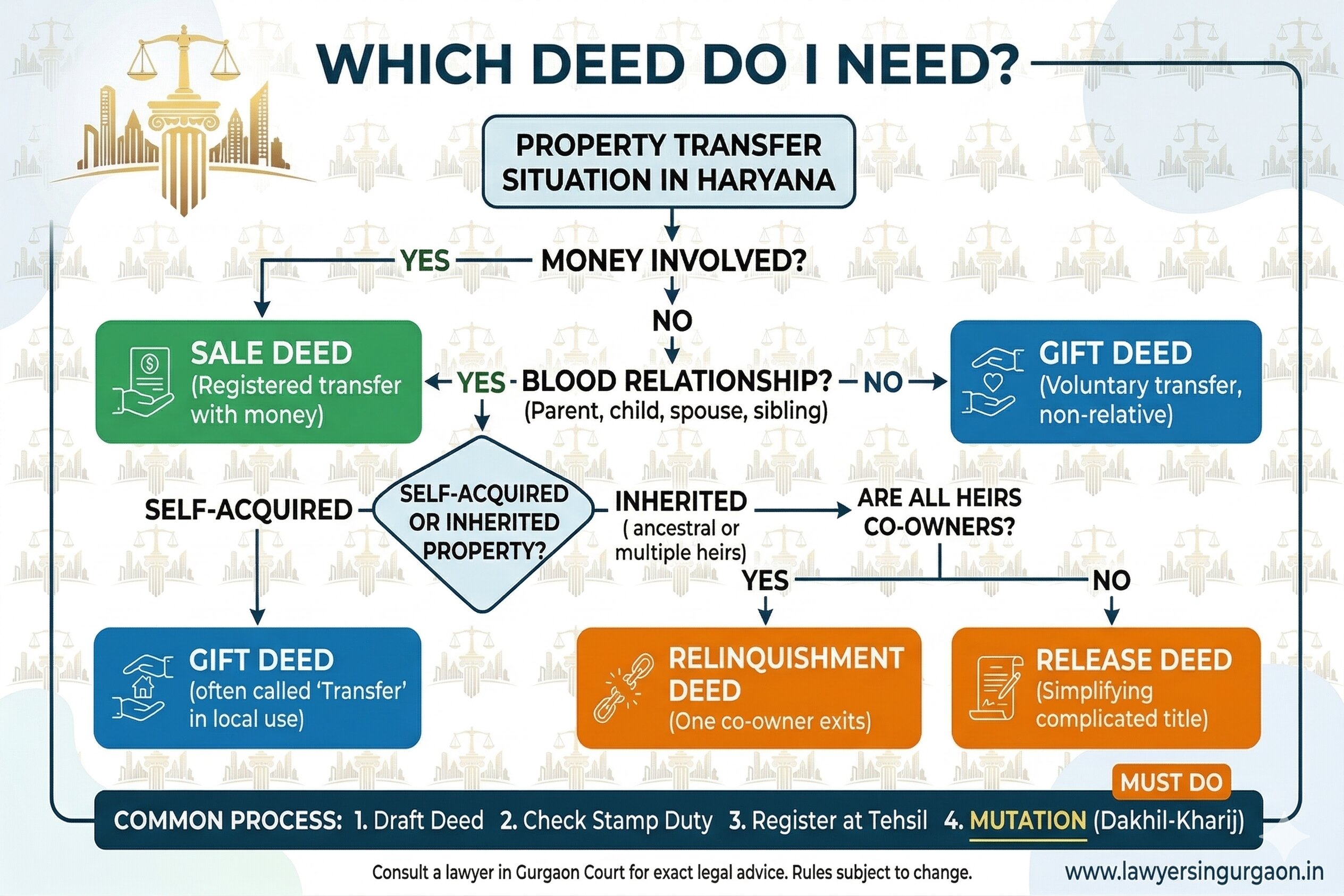
The exact document choice still depends on title history, relationship category, inheritance position and the factual structure of the transaction.
Which document may fit common Haryana property situations?
The most useful way to understand this topic is through real-world decision scenarios. These are broad illustrations only. Actual drafting should always follow the exact title position and factual matrix.
Parent wants to transfer self-acquired property to son or daughter without sale price
In many such situations, a Gift Deed is often the first document examined because the transfer is voluntary and not a sale. In Haryana practical usage, some people may also refer to such family transfer as transfer deed within blood relation.
- check present title carefully
- confirm whether the property is self-acquired
- review whether any other claim or restriction exists
One co-owner wants to give up share in jointly held property
This may not always be best handled as a Gift Deed. Depending on facts, a Relinquishment or release-type structure may be more suitable.
- important in inherited or jointly devolved property
- share structure matters
- wrong deed can complicate future due diligence
Property is being transferred for money
If payment is actually involved, casually calling it gift or transfer deed can be misleading. Such cases may need a Sale Deed or another consideration-based structure.
- transaction value matters
- duty logic differs
- loan and valuation issues may arise
Family wants to settle future disputes among members
Where the real goal is broader family adjustment rather than a straightforward gift, a Family Settlement may deserve closer consideration.
- useful where multiple members have competing expectations
- drafting clarity becomes critical
- title history should be checked carefully
Spouse transfer without sale consideration
Depending on ownership history and transaction facts, a Gift Deed may be examined. But it should still not be handled casually. In practice, users often search for transfer deed in such family situations because they are trying to understand blood relation transfer treatment.
- check present ownership first
- check whether any loan or encumbrance exists
- check record correction and mutation needs
Inherited property among siblings or legal heirs
This is one of the most misunderstood areas. A Gift Deed is not automatically the best answer merely because the parties are relatives. In many inherited property situations, relinquishment, release or family settlement may require closer examination.
- succession history matters
- existing shares and possession matter
- mutation trail should be reviewed
Relinquishment or release deed within family property context
Relinquishment or release deed is often examined where a person already has an existing share in property and gives up that share in favour of another co-owner or heir. In family situations, this commonly arises in inherited property rather than in ordinary self-acquired transfer.
- property inherited from parents or ancestors
- multiple legal heirs holding recognised share
- one heir giving up share in favour of another heir or co-owner
- family adjustment after succession mutation
Authorities may expect that the property is clearly shown to be inherited property in which the parties already have a recognised share.
Especially for agricultural land, the inheritance mutation chain may need to clearly reflect succession position before such structure is treated as appropriate.
Gift Deed vs Relinquishment Deed vs Family Settlement
Many users searching for transfer deed in blood relation are actually trying to solve one of three very different legal problems.
Usually examined where one owner voluntarily transfers rights without sale consideration, but stamp duty may still apply on collector rate depending on the structure and relationship category.
Often relevant where a co-owner or heir gives up an existing share in inherited or jointly held property in favour of another person already connected to the title.
Often considered where the real objective is family adjustment, dispute prevention or distribution clarity rather than a one-way gift.
Stamp duty and registration implications in Haryana
Users often search this topic because they want to know:
- which deed may cost less
- whether blood relation transfer gets different treatment
- whether family transfer can be handled more efficiently than a sale
The answer depends on the actual instrument used, the relationship between parties, the nature and location of the property, and the prevailing requirements at the time of registration.
Transfer within blood relation is often discussed in Haryana as a category different from ordinary sale transaction. In limited recognised relationships, it may be associated with exempt or concessional stamp duty treatment.
However, Gift Deed may still attract duty on collector rate even where no money transaction is happening between the parties.
People sometimes assume that every family transfer is automatically exempt. That can backfire. Stamp duty treatment depends on the exact relationship, the correct deed chosen, proof of title position and the factual category involved.
For exact payable amounts, the final calculation should be checked at the time of drafting and registration with reference to the then-applicable requirements and the specific transaction facts.
What can go wrong if the wrong deed is chosen?
- mismatch between document language and actual transaction
- title objection during future resale or legal due diligence
- unnecessary stamp burden or avoidable registry issue
- future dispute among family members
- mutation or record correction complications
- difficulty in loan processing or resale documentation
The problem is not only at the Sub-Registrar stage. A wrongly structured transfer can continue causing trouble years later when the property is resold, inherited again or checked by a bank or buyer.
Typical process for property transfer document registration in Haryana
Mutation after Gift Deed or other property transfer
A major practical mistake is assuming that once the deed is registered, the entire job is over. In reality, registration and mutation are not the same thing.
- ownership and revenue records may still need updating
- future resale may depend on clean record trail
- old entries can create confusion during due diligence
- inherited property needs extra caution
Depending on the property and record position, post-registration follow-up may still be required, especially where the transfer is within family or linked to inherited title.
In agricultural land cases, succession history reflected through mutation entries may play an important role in determining the correct document structure.
Where transfer is based on inherited title, authorities may examine mutation chain showing inheritance position before accepting certain family transfer structures.
In some agricultural land cases, two or even three inheritance mutations may need to be visible in the record chain to properly establish how the present share has flowed from ancestor to current holder.
If that chain is not clear, the chosen family transfer document may face difficulty or objection.
Frequently asked questions
Is transfer deed a proper legal name by itself?
In common usage, people often say transfer deed generally. In Haryana practice, it is also frequently used for family transfer within blood relation, but legally the correct document still has to be identified more precisely from the facts.
Can property be transferred to a son or daughter through Gift Deed?
In many family situations, Gift Deed is the document people examine for such transfers, but title clarity, relationship category and stamp duty treatment should still be checked first.
Is Gift Deed always the cheapest option?
Not necessarily. In Haryana practical situations, Gift Deed may still attract duty on collector rate even where there is no sale consideration. The legally correct deed should come first.
What if the property is inherited and siblings want to adjust shares?
That often needs careful analysis. Depending on the facts, Gift Deed may not be the most appropriate solution. Relinquishment, release or family settlement may require closer examination.
Does registry automatically complete mutation?
No. Registration and mutation are separate practical concerns. Post-registration follow-up may still be needed.
Why does deed choice matter so much?
Because it affects not only registry formalities, but also future title safety, resale, due diligence, mutation and dispute exposure.
Related property law guides
Unsure whether your case needs Gift Deed, Sale Deed, Relinquishment or another transfer document?
If the property is in Gurgaon and Delhi NCR and you are unsure about the correct structure for a family transfer, inherited share transfer, co-owner release or other non-sale transfer, it is better to review the papers before registry rather than correct title problems later.
- Share your basic property details
- Tell whether any money is involved
- Mention whether the property is self-acquired, inherited or jointly held
- Ask which deed appears more suitable on the facts
This article is a practical informational guide and does not replace document-specific legal advice. Exact drafting, family transfer treatment and deed choice depend on the facts, title record, relationship category and prevailing requirements at the time of execution.